
PolicyLink's vision for a nation that governs for all
Interview with Katy Lackey, Senior Associate, Water Equity & Climate Resilience, PolicyLink
1. Tell us about PolicyLink and its impact.
PolicyLink is a research and action institute working to advance a nation that truly governs for all. We advance structural solutions, shape conditions, build connections, and strengthen the field infrastructure needed to deliver on the promise of a nation where all can thrive. Founded in 1998 by the incredible Angela Glover Blackwell, the organization set out to advance racial and economic equity by connecting community-driven solutions to national policy. This was at a time when equity work was far from mainstream and there were no real policy think tanks located outside of Washington, DC – our headquarters is in Oakland, CA – let alone very few Black-led organizations driving policy change at the national level. Developing and advancing policy with those most impacted by issues has remained a cornerstone of our work since. Today, it is led by CEO Michael McAfee and President Ashleigh Gardere, and is committed to advancing a nation that governs for all.
2. PolicyLink is not a water-specific organization then. How’d it get started in water, and what kind of water work does it do?
Our water work was really born from the devastating consequences of a failure of government in the wake of Hurricane Katrina. PolicyLink was one of the first organizations on the ground in New Orleans, supporting local leaders in Black and Brown communities in their efforts to rebuild over the next decade. Though much of this work was focused on housing justice amidst a water disaster, the close partnership between Kalima Rose of PolicyLink and Colette Pichon Battle of the Gulf Coast Center for Law & Policy would eventually turn more specifically to water. In 2018, the two organizations worked with about 15 other frontline and justice-led organizations to establish the Water Equity & Climate Resilience (WECR) Caucus, with Kalima and Colette as the co-chairs. PolicyLink opened the door to national policy development and networks; GCCLP brought frontline priorities, ideas, and solutions.
Today, the Caucus is a national network of over 80 frontline and allied organizations whose collective vision is to live in a world that honors water, promotes generational climate security and water affordability, and builds frontline leadership for systems change. The Caucus is anchored by PolicyLink and governed by a Steering Committee of 12 organizations, ⅔ of which are frontline/justice representatives. We work collaboratively toward our vision through four main strategies: federal policy development and advocacy, narrative change, leadership capacity, and movement building.
When the Bipartisan Infrastructure Law (BIL/IIJA) passed in 2021, PolicyLink began to expand our water work beyond the WECR Caucus. Suddenly there was a huge influx of water infrastructure funding into an important, albeit imperfect system, the State Revolving Funds (SRFs). We knew getting these funds to communities that need them the most and for projects that could close water access and equity gaps would be a challenge. So PolicyLink partnered with the Environmental Policy Innovation Center (EPIC), River Network, and the Alliance for Great Lakes to establish the SRF State Advocates Forum, a community of practice now 127 organizations strong and advocating for SRF reforms across 34 states and at the national level.
 PolicyLink also worked with Community Water Center, Verde, and We the People of Detroit to analyze Drinking Water SRFs in CA, OR, and MI and supported equity-based policy reforms. Following this, we worked with community-based organizations (CBOs) in 7 Southern states to conduct equity analyses of both the Drinking Water and Clean Water SRFs, and shore up CBO-led state-based advocacy efforts in Alabama, Kentucky, Louisiana, and Texas to deliver more equitable outcomes. Later this year, we’ll kick off phase three of this work, this time looking at innovative state financing mechanisms and policies for equitable water infrastructure in Southern States.
3. Working directly with communities and frontline leaders on water equity is an important approach. Can you share a success story or accomplishment based on this approach?
We’ve had many accomplishments, but one I’d like to highlight relates to the WECR Caucus’ federal policy strategy. EPA’s Water Affordability Needs Assessment (2024) found that between 30 and 48 million people in the United States can’t afford their water bills. While a much needed and groundbreaking study, this number is based on limited data from around 20 states. So it’s likely much higher. The Caucus’ Water Affordability for All Platform includes three pillars: (i) funding for infrastructure and operations, (ii) community-driven solutions for chronically failing systems, and (iii) maintaining household access and keeping bills affordable.
In late 2024, Representatives Rashida Tlaib (D-MI) and Debbie Dingell (D-MI) introduced the Half-Century Update for Water Access and Affordability Act (H2O UP Act), to establish the first-ever permanent, federal low-income water assistance program in the U.S. Environmental Protection Agency (EPA). At a time when public water systems in the U.S. are facing rising costs of outdated infrastructure, climate change, and necessary public health safeguards, we cannot pass on this burden to low-income households. The WECR Caucus worked closely with Tlaib’s office on the development of this legislation as a first necessary step to address the U.S. water affordability crisis. WECR members were able to share their challenges and needs directly with federal policymakers, and uplift models and solutions from local and state levels that they had been championing to help inform a national program. We will continue to work with these–and other offices–to champion and reintroduce versions of this legislation this upcoming year.
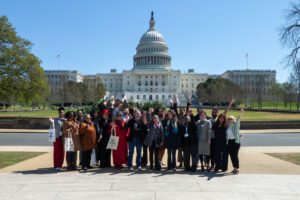
We’ve also seen successes for individual WECR Caucus member organizations supported by our work. In 2024 and 2025 we hosted a Federal Policy Cohort, working with 4-6 frontline organizations each year providing financial resources and 1:1 policy advising support to understand and effectively navigate the federal water landscape, and connect local policy priorities to federal efforts. As part of their year-long work and training, Cohort participants visited Washington DC during Water Week to engage in federal advocacy. Last year, the Giniw Collective, a Native-led environmental organization, successfully worked with federal partners to remove a provision in the “One Big Beautiful Bill” that would lift a ban on mining in the Boundary Waters. This established a critical safeguard for these waters, and Giniw is continuing the fight for water protection at the state level in Northern Minnesota.
4. PolicyLink has 6 focus areas: Governing for All, Business and Investment, Housing Futures and Land Justice, Infrastructure, Water Equity and Climate Resilience, and Place-Based strategies. How do you work across these areas to achieve your mission?
PolicyLink is working to redesign the nation so that it governs for all. We draw our mandate to do this critical work from the 13th and 14th Amendments, which we believe offers a living constitutional framework to transform how our nation governs. They call us to build institutions that actively deliver equal protection for all, and we believe this is manifested in material changes in the lives of people in this nation, through water, housing, transportation and infrastructure, and business.
Across all of these focus areas, we are concentrating on how we can reshape legal and regulatory systems, government at all levels, and policies to embody a consciousness that embraces the humanity of every person and finally deliver outcomes for everyone. One important way we are doing this is by bringing different sectors together at the 2026 Summit at the end of August at National Harbor outside of Washington, DC. This will be an opportunity to bring together everyone so we can foster an imagination for a nation that governs for all, believe we are the ones that will help design it, and ultimately take action together to bring it into reality.
I’ve been in the water sector for over a decade now. Three truths have persisted in this time. First, we know that the way we have governed water and designed infrastructure in the past is no longer sufficient for the challenges we face today – let alone will face in the future. Second, collaboration and partners are absolutely essential in achieving One Water. And third, the need to ensure affordable, accessible, and resilient water systems can no longer afford to be invisible. In fact water must be elevated as a national priority. What better way to do this than weave water into the very fabric of our democracy, into our country’s next founding?
5. What are you most excited about when thinking about PolicyLink’s work in 2026?
On a tangible level, I’m excited for our WECR delegation to Water Week in April. This will be the third year PolicyLink has anchored a group of WECR frontline organizations to visit DC, share their stories with decisionmakers, and advocate on shared priorities around water infrastructure funding, national data collection, and a permanent low-income water assistance program.
But perhaps what I’m most excited for with PolicyLink’s work in 2026 is, well…inspiration. Our nation is in a devastating time of political polarization, whiplash, and the dismantling of democratic rights and critical environmental protections. Every day brings a heartbreak. On the good days, it would be easy to feel constantly on the defensive; on the bad days, utterly hopeless. I feel so lucky to work at an organization that is really living the promise of how it is asking our nation to step up. We get to dream big, to think about and pursue the structures, systems, and policies that can deliver the promise of our nation’s founding, and to leverage power across sectors at the Summit. I get to help build the world we all want–and deserve–to live in. What’s better than that?