Turning Water Quality Research into Real-World Solutions
Interview with Kayla Callejas, Associate Director Water Quality Research Foundation
1. Tell us about Water Quality Research Foundation and its impact.
The Water Quality Research Foundation (WQRF) is a non-profit scientific research foundation with the mission to advance the knowledge and science of high-quality, sustainable water. Everything WQRF does centers around improving water quality through credible, independent, third-party research. Since its founding in 1952, WQRF has funded research that help scientists, utilities, regulators, and water treatment professionals better understand contaminants, treatment technologies, and emerging water quality challenges.
From supporting research on PFAS and other emerging contaminants to developing tools like the National Contaminant Occurrence Map, WQRF provides trusted, data-driven resources that help communities make informed decisions about their drinking water.
2. What sets WQRF apart from other organizations focused on improving the quality of drinking water in the United States.
While many organizations focus on source water protection or municipal treatment, WQRF is uniquely focused on the science behind water treatment solutions deployed at the Point-of-Entry (POE) and Point-of-Use (POU) in homes, schools, and businesses. We fund applied research on emerging contaminants, treatment performance, and consumer impacts, then translate those findings into practical tools and resources that help consumers, water professionals, and decision-makers make better water quality decisions.
3. You all provide grants focused on water quality-related research – can you share a previous project that received funding and how it has helped move the industry forward in terms of knowledge in the field.
Dr. Zhi (George) Zhou at Purdue University has become a trusted research partner of WQRF, leading multiple studies that address the industry’s most pressing questions about per- and polyfluoroalkyl substances (PFAS). While an earlier WQRF-funded grant focused on removing PFAS from drinking water, a more recent study tackled an equally important question: What happens to PFAS after they are captured by treatment technologies and those filters reach the end of their service life?
The results showed that under simulated landfill conditions, POU reverse osmosis, ion exchange, and activated carbon retained PFAS at extremely high levels – ranging from approximately 99.83% to greater than 99.99%.
What makes this project so impactful is that it addressed a critical knowledge gap. It’s not enough to understand how effectively technology removes PFAS from drinking water; we also need to understand what happens to those contaminants afterward. The study provided independent data that can strengthen consumer confidence and help regulators, waste managers, and water treatment professionals make informed decisions about the long-term management of PFAS treatment residuals.
4. Your contaminants map helps people visualize contamination in public drinking water sources. Where does this data come from and why is a nationwide map needed? How would you want communities and water professionals to use this data? Any plans bring in data after 2023?
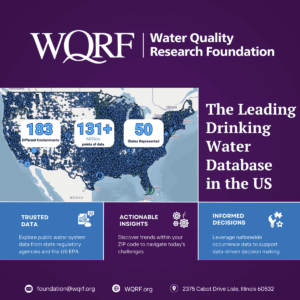
WQRF’s National Contaminant Occurrence Database was built in partnership with Corona Environmental Consulting using data collected from state primacy agencies and national monitoring programs. It contains information on 183 contaminants, more than 130 million data points, and represents drinking water systems in all 50 states. As the most comprehensive public drinking water contaminant occurrence database currently available, it provides insights into finished drinking water quality and emerging contaminant trends.
The Contaminant Map uses a subset of the data and represents 16 common contaminants and 6 PFAS compounds. We hope communities use the map as an educational resource to begin learning more about their drinking water. The map allows users to enter a ZIP code to explore water quality in that area. For water professionals, it can be a valuable tool for supporting customer conversations with data-driven insights.
We’re currently at the tail end of another round of data collection, with the updated dataset launching in September 2026.
5. Many folks are familiar with water coming from their water utility or well on their property, but can you better explain the difference between Point of Use and Point of Entry filtration and why these may be the answer to water quality issues for some communities.
Point-of-Use (POU) systems treat water where it is consumed, such as a kitchen faucet, refrigerator dispenser, or countertop pitcher. Point-of-Entry (POE) systems treat water where it enters a building, providing treated water throughout the entire home or facility.
Neither approach is better; the right solution depends on the contaminant and the treatment goal. A POU system may be highly effective when the primary concern is improving drinking and cooking water, while a POE system may be preferable when addressing issues such as hardness, staining, taste and odor concerns, or contaminants that affect water throughout the home.
POU and POE technologies offer a fast, targeted, and cost-effective way to reduce exposure to contaminants, which is especially valuable for those who rely on private wells. For customers of municipally treated water, POU and POE act as a final barrier, further reducing contaminant levels beyond regulatory requirements and offering protection from contaminants that may be introduced by the distribution system.
6. What are you most excited about when thinking about WQRF’s work in 2026?
Ultimately, what excites us most is the opportunity to connect research, education, and real-world implementation. Several efforts underway this year are critical to advancing that mission.
We’re excited about our ongoing PFAS research, conducted in partnership with NSF International, which could streamline POU and POE testing and certification by leveraging a smaller number of carefully selected compounds as surrogates for a broader range of PFAS – saving both time and money while maintaining scientific rigor.
Also, WQRF is aligning with the Association of State Drinking Water Administrators (ASDWA) and the Rural Community Assistance Partnership (RCAP) to scope research on POU and POE treatment as compliance solutions for small drinking water systems. Their engagement ensures the project addresses the real-world challenges faced by systems that need additional compliance options the most.
Through educational resources, industry partnerships, and interactive tools, we’re putting research into the hands of the public, utilities, regulators, and water professionals who can use it to protect our drinking water.