
Building Partnerships for a Healthier Chesapeake Bay Watershed
Interview with Kate Fritz, Chief Executive Officer, Alliance for the Chesapeake Bay
1. Tell us about Alliance for the Chesapeake Bay and its impact.
The Alliance was founded in 1971. For 55 years we have been focused on restoring the lands and waters of the Chesapeake Bay watershed. We have a collaborative and action-oriented approach that delivers on-the-ground solutions, provides technical assistance, and builds capacity to achieve healthier lands and cleaner water. We have a passionate and growing team of subject matter experts who implement solutions upstream, where the Bay needs us the most, addressing pollution before it reaches our rivers and the Bay.
2. There are many organizations focused on the Chesapeake Bay region and restoring the health of the Bay, where does the Alliance fit into this work?
The Chesapeake Bay watershed is home to over 18 million people who live, work, and play in our communities. At the Alliance, we believe that we all have a role to play and that we must work together to achieve shared goals. Our approach is a collaborative one that allows us to work across sectors and regions, uniting communities, companies, and conservationists to improve the health of our watershed.
3. The bay region spans 6 states and DC, how do you all decide where and who to work with?
This is one of the most unique and exciting things about the Chesapeake. Our watershed spans 64,000 square miles and has a land-to-water ratio of 14:1, which is larger than any other coastal waterbody in the world. All of that land means that we have a big opportunity to make a positive impact on the land by addressing pollution upstream. Apart from our collaborative approach, one of our greatest differentiators is that our focus is upstream, on the land. From our four offices in Maryland, DC, Virginia, and Pennsylvania to our four program areas, we implement solutions that are designed to address pollution long-term and keep it from reaching our waterways across the watershed.
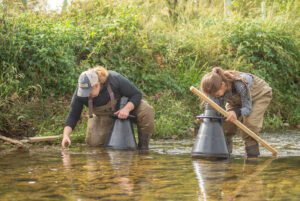
Lancaster Water Quality Monitoring
4. Can you share with us a specific project related to one of your four pillars (Agriculture, Forests, Green Infrastructure, and Stewardship and Engagement) and how your action-oriented approach was used to implement the project.
Each of our programs is designed to work in unique ways across the watershed, so it’s rare for one project to incorporate all four programs. However, each year we produce an impact video that captures recent accomplishments. Our 2026 impact video, which premiered in September, offers a glimpse at just four of our many projects across the watershed. Beginning in the headwaters, where our Agriculture Team is helping a Virginia farmer fight drought and improve water quality, our journey then takes us to the western shore of the Chesapeake Bay, up the Susquehanna to Lancaster, Pennsylvania, and wraps up with two exciting events in Maryland and Virginia.
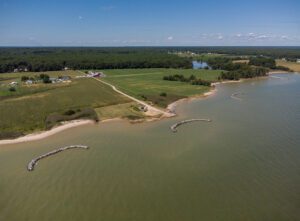
Trossbach Living Shoreline
5. You all set ambitious goals in 2023 for what you hope to accomplish by 2028. Is there an area or target where you’re seeing significant promise for reaching your goal or areas where you’ve had to rethink the target.
In 2023, we set goals to help us focus on achieving our mission of restoring our lands and waters. We track 19 indicators that align with our five Strategic Plan Goal areas. Within those 19, we have quite a few metrics where we have exceeded our goal, and where we have had to update our targets because we are ahead of where we expected to be. Many of our targets measure our external mission impact – like Forest Restoration (79% complete towards 3,000 acres planted goal by 2028), and number of Volunteers (97% of 16,000 individuals goal by 2028) – show how our boots-on-the-ground work adds up to real and tangible outcomes. And some of our internal metrics, like % Staff Retention (97.5% retention with a goal of 92%) demonstrate our focus on attracting and retaining great staff. Our Strategic Plan is focused on delivery of our mission, and a recognition that a strong organization internally means we can meet the demands of our rivers and streams more concertedly. When staff stick around to build long-term relationships, the hard work has a foundation to continue to thrive.
6. What are you most excited about when thinking about the Alliance’s work over the next year?
As the regional organization with the largest on-the-ground impact, we are excited to continue to stay focused on clean water outcomes. As an organization that has been working for 5+ decades, we know that the relationships we build now are the ones that will continue to benefit our communities and partners well into the future. With one foot in the present and one foot in the future, the Alliance is looking forward to continuing to innovate on ways to expedite the delivery of clean water solutions through long-term partnerships. That’s how we got started, and where we will continue to head.